
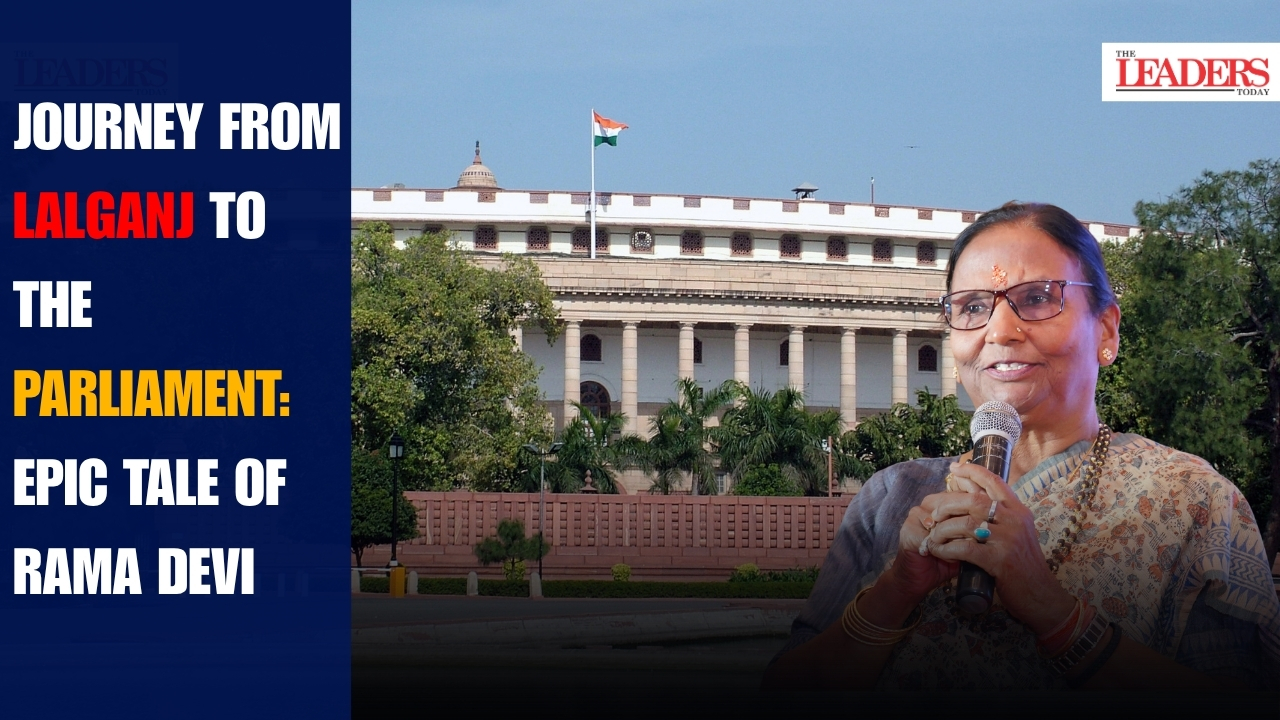
Journey from Lalganj to the Parliament: Epic Tale of Rama Devi
by The Leaders Today
On May 5, 1949, a girl known as Rama Devi grew up in the little town of Lalganj, in the parched heartlands of Bihar. Her life first appeared to be similar to any other family in the village: humble, rooted, and enmeshed in the customs of rural India. But there was a longing to smash down walls that burned beneath her silent determination.
Rama Devi was raised in a traditional household and experienced hardship and simplicity in her early years. Her mother, Dharbharan Devi, and father, Kailash Prasad Chaudhary, placed a high emphasis on education and made sure their daughter received more than a rudimentary education. She later obtained a law degree after graduating with a degree in economics, which was unusual for women in Bihar at that time. Rama Devi, however, pursued more than just academia. She had a far bigger vision: public service.
She wed Brij Bihari Prasad, a developing Bihar political figure, in 1965. Even though his ensuing murder left a lasting impact, it marked a sea change in Rama Devi’s life. Purpose emerged from grief. She embraced public life to leave her legacy rather than inherit one.
As part of the Rashtriya Janata Dal (RJD), she won election to represent the 12th Lok Sabha representing Motihari in 1998, marking her young woman’s foray into national politics. However, politics, particularly in Bihar, called for perseverance and was not a smooth rise. She changed her political affiliation, eventually joining the ruling Bharatiya Janata Party (BJP), which she believed more accurately represented her values of discipline and progress.
Her leadership was truly put to the test in 2009 when she ran from Sheohar, a region afflicted by issues including disparities in gender, impoverishment, and the absence of infrastructure. She succeeded. Then, with a greater obligation, they triumphed again in 2014 and again in 2019. She evolved into the first Member of Parliament to prevail over Sheohar three times in a row, signifying progress and loyalty.
She advocated on behalf of women without prenatal assistance, widows seeking pensions, areas without sanitary facilities, and girls who were forbidden to attend school. She saw law as action rather than theory. With the power of a warrior and the esteem of a mother, she carried the hopes of millions.
A disparaging comment made about her in Parliament in July 2019 was one of the pivotal moments in her career. At that point, she was in authority of the House. Rama Devi refused to comply with a simple apology and remained firm. She called for responsibility for all women who have been marginalized, silenced, or mocked, not just for herself. Her disobedience garnered national notice and served as a reminder to India that honor is a right, not a favor.
Along with the political process, Rama Devi is well-known for her commitment to spirituality, kabaddi, and horticulture. She never lost sight of her origins, frequently visiting her constituency, strolling along the muddy streets, and paying close attention to her people. She felt that change in the tiniest of homes was what politics was all about, not speeches in Delhi.
There is more to her story than just being a politician. It is the story of a mother with five children who evolved into the voice of millions, an exemplar who spoke with empathy and conciseness, and a woman who stood up in a world ruled by men.
Rama Devi’s journey, from the narrow alleyways of Lalganj towards the sanctified chambers of the Legislative Assembly, is proof of how bravery, knowledge, and compassion can create not only an occupation but an enduring impact.