
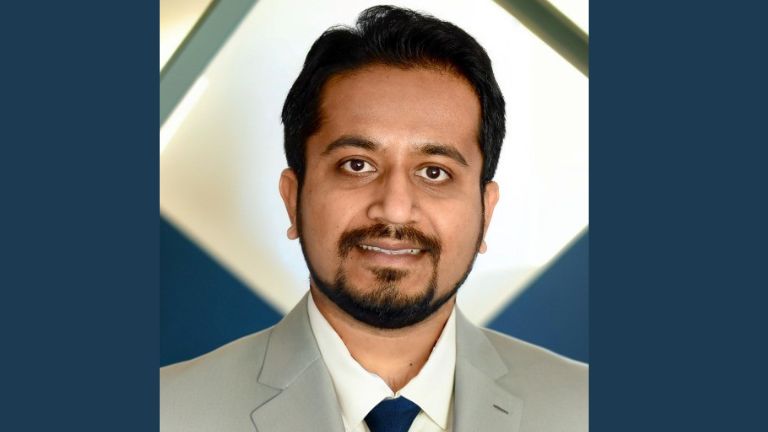
Mr. Dhruvitkumar Patel – USA (Global Leaders Awards – Conclave & Summit 2025)
by The Leaders Today, 14 Nov 2025
Mr. Dhruvitkumar Patel
Software Engineer at Staten Island Performing Provider System, LLC
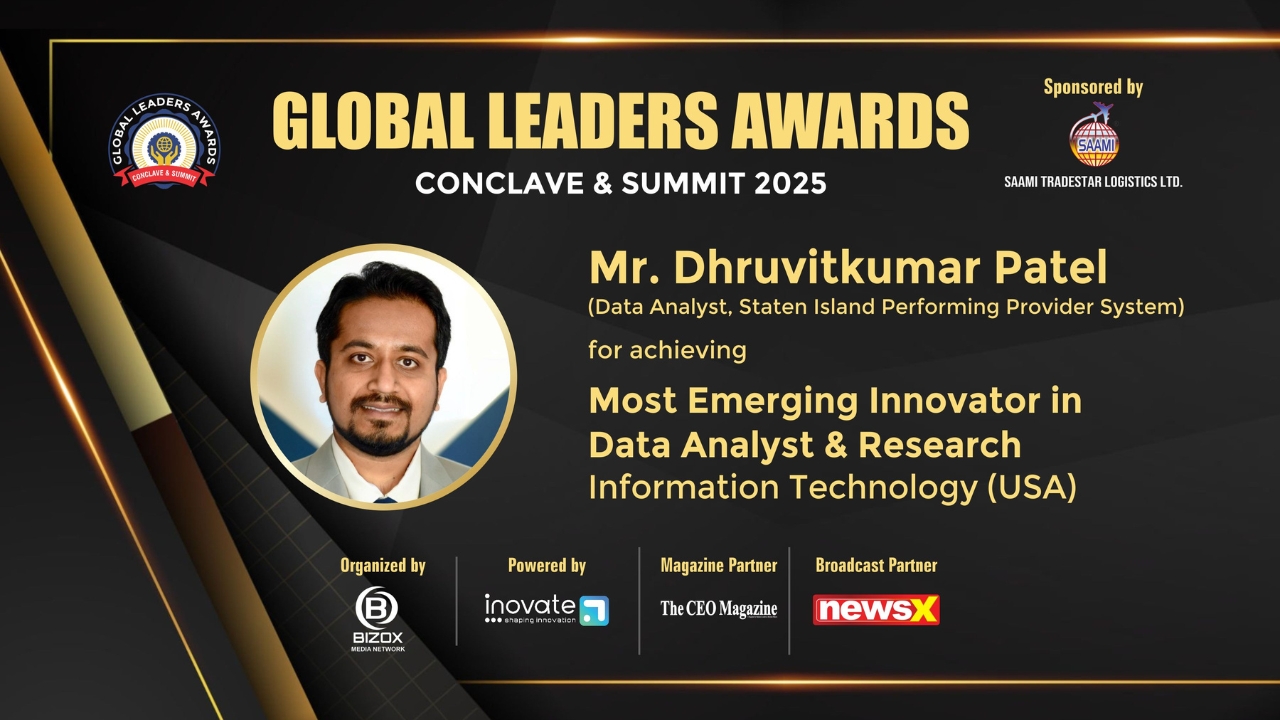
Awarded by Bizox Media Network as a “Most Emerging Innovator in Data Analyst & Research – Information Technology (USA)” at Global Leaders awards 2025– Conclave & Summit recently held in Kuala Lumpur, Malaysia.
The Global Leaders Awards 2025 is one of the world’s most distinguished corporate recognition platforms, celebrating exceptional leaders, visionary companies, and outstanding organizations for their innovation, perseverance, creativity, performance, and excellence.
Who has influenced your life and leadership style most profoundly?
The most profound influence on my life and leadership style comes from my mentors in academia and the early days of my career who successfully bridged theory and practice. These individuals weren’t just brilliant researchers; they were master engineers who could take a complex mathematical model and turn it into a robust, deployable system. They instilled in me the idea that true leadership in technology isn’t about knowing the most complex theory, but about simplifying that theory into scalable, reliable solutions that deliver value. They taught me the virtue of rigor in design and humility in execution. This influence directly shaped my “Strategic Empathy” quality, ensuring I always focus on building solutions that are not just technically advanced, but genuinely usable and effective for the people on the ground, whether they are financial analysts or healthcare providers.
When the options are unclear and the risks are great, how do you make challenging decisions?
When I face high-risk, ambiguous decisions—which is common when deploying cutting-edge AI or migrating critical infrastructure—I rely on a data-driven, multi-stage framework coupled with a rigorous risk assessment based on ethical principles.
First, I quantify the ambiguity. I demand that every hypothesis about potential outcomes be supported by the clearest available data, even if that data is incomplete. We use simulation and modeling to map out the probabilistic outcomes of each path. Second, I look at the security and ethical impact of each option. When the options are unclear, the guiding light must be the long-term integrity and trustworthiness of the system. For instance, in healthcare, a decision must always prioritize patient data privacy above all else. Finally, I adopt a bias for phased execution. Rather than committing to one option entirely, I seek the smallest, safest pilot project that can validate the riskiest assumption. This approach minimizes exposure while gathering the real-world data needed to make the final, informed commitment.
Which book or piece of fiction has influenced your perspective the most?
While much of my reading is technical, the book that most influenced my professional perspective is “The Goal” by Eliyahu M. Goldratt. Though presented as a piece of fiction about manufacturing, its lessons on the Theory of Constraints are universally applicable, especially in data engineering. The core idea—that every system, no matter how complex, is limited by one constraint—taught me to stop chasing marginal improvements across the board. Instead, I learned to ruthlessly identify and optimize the single, most constraining factor in a data pipeline, a software deployment, or a business process. This fundamental principle has been crucial to my success in automating processes and designing efficient data architectures, ensuring my efforts are always focused on maximum leverage.
What is the biggest sacrifice you have ever had to make for your job or career?
The biggest sacrifice I’ve made has been the reduction of personal time and focused energy on family and outside interests during crucial research and development periods. The process of securing two patents, earning multiple Best Paper Awards from IEEE, and simultaneously holding a demanding technical role requires intense, prolonged focus. There were many late nights and weekends spent ensuring the code was secure, the research was sound, and the final solution was robust before deployment. While I am incredibly proud of those achievements, the trade-off was a period where my capacity to be fully present for loved ones was undeniably diminished. It’s a constant challenge to balance the relentless pace of innovation with the deep importance of maintaining those personal connections.
Which values would you like to pass on to the next generation?
I would like to pass on three core values to the next generation: Rigor, Responsibility, and Resilience.
Rigor means demanding precision in their work—writing clean code, verifying data, and understanding the theoretical ‘why.’ Responsibility is paramount, especially in data science. They must recognize that every algorithm and data pipeline they build has real-world, ethical consequences, and they must prioritize security, privacy, and fairness above all else. Finally, Resilience—the commitment to keep learning and pushing through the inevitable failures. In our field, you will face complex problems that no one has solved yet. They must have the grit to embrace those obstacles as opportunities for groundbreaking innovation.
How does your personal life and family affect your leadership style?
My personal life and family significantly reinforce the “Strategic Empathy” in my leadership style. My professional work at Staten Island PPS is ultimately about improving community health, which is a cause deeply rooted in personal and familial well-being. This perspective grounds my work in human value, reminding me that the data points I analyze represent real people and their futures. It gives my engineering efforts a deeper purpose, transforming technical goals into meaningful, shared objectives. It also fosters a commitment to work-life integration for my team, recognizing that peak performance is sustained by balancing professional demands with personal health and family life.
How would you differentiate your leadership style from others?
My leadership style can be differentiated by its focus on “Empowering Analytical Ownership.” Many leaders in my field focus on delegating tasks; I focus on delegating the entire problem space. I combine my background as a hands-on Software Engineer with my identity as a Data Analysis Researcher. This means I lead by setting a clear vision for the data intelligence we need, then empowering my teams to choose the most rigorous and innovative engineering path to get there. I don’t micromanage the how, but I hold the team accountable for the integrity and impact of the final outcome. I seek to develop not just contributors, but future technical leaders who possess both engineering skill and research insight.
Which three personal attributes do you think were most important to your success as a leader?
The three personal attributes most important to my success as a leader are Intellectual Curiosity, a Bias for Execution, and Integrity.
Intellectual Curiosity drives innovation. It’s the attribute that compels me to stay ahead of the curve, leading to my patents and research publications. A Bias for Execution is essential because in our field, ideas must become reliable, working systems. It ensures we move past theoretical debate into delivering tangible results. Lastly, Integrity—in data handling, ethical conduct, and communication—is the cornerstone of all trust. Without integrity, a leader’s data insights are worthless, especially in sensitive sectors like finance and healthcare.