

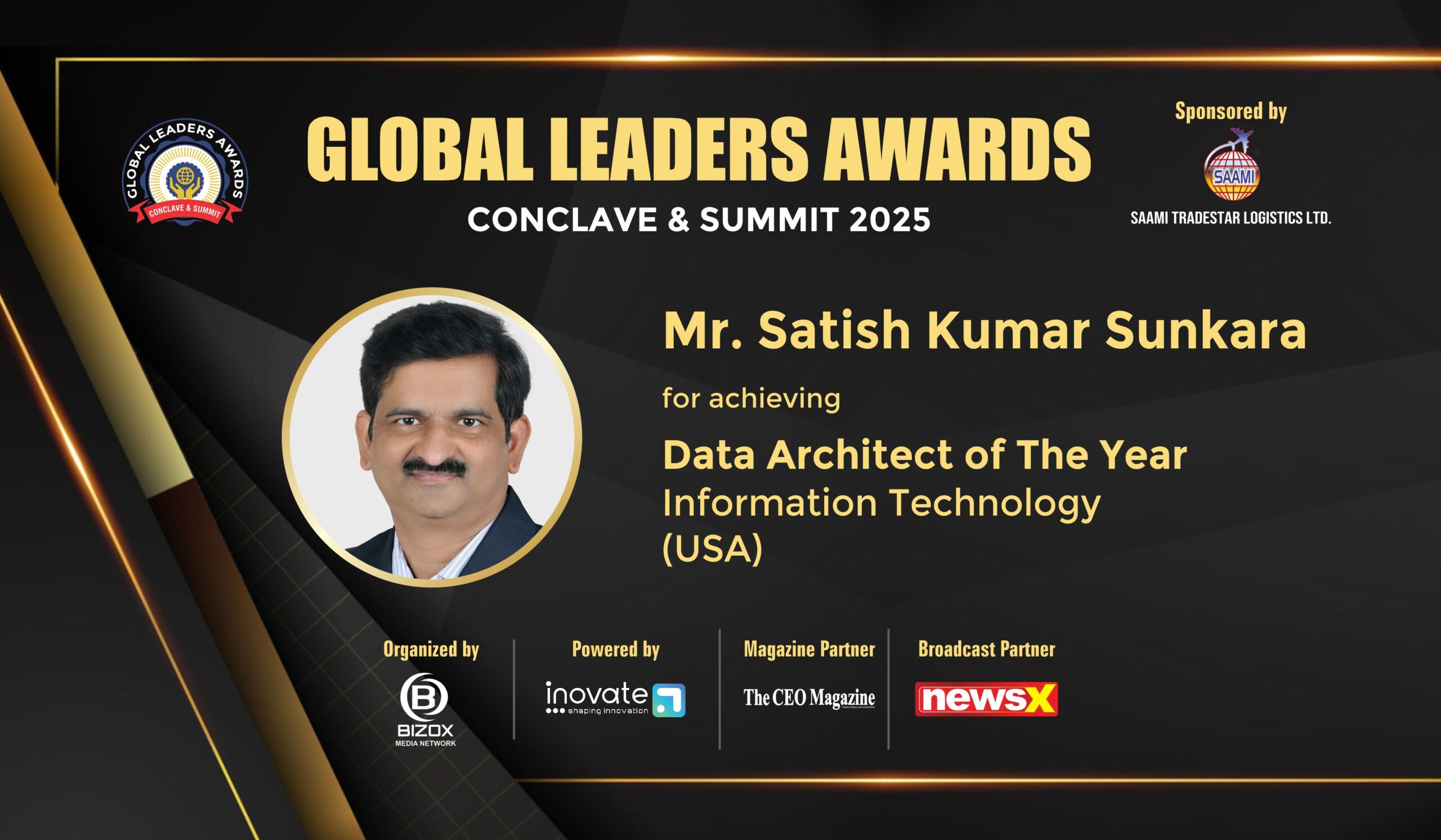
Mr. Satish Kumar Sunkara – USA (Global Leaders Awards – Conclave & Summit 2025)
by The Leaders Today, 22 Dec 2025
Who has influenced your life and leadership style most profoundly?
The person who has most profoundly influenced my life and leadership style is my father. His discipline, honesty, and calm approach to adversity have shaped who I am today. Growing up, I watched him treat everyone with respect and fairness, regardless of their position or circumstances. This taught me that leadership is not about authority alone, but about leading by example and doing the right thing, especially when it is difficult.
His belief in my abilities encouraged me to pursue engineering, build a career in data science, and ultimately step into leadership roles. As a Principal Data Scientist, I draw on his lessons every day—staying grounded, listening carefully, and making thoughtful, principled decisions when guiding my teams and projects.
When the options are unclear and the risks are great, how do you make challenging decisions?
When options are unclear and the stakes are high, I follow a structured, evidence-based approach. First, I clarify the problem and gather all available data, including historical examples and relevant research. My background in clinical trials and machine learning has reinforced the importance of letting data and rigorous analysis guide decisions, especially when patient outcomes or regulatory obligations are involved.
Next, I bring key stakeholders and team members into the discussion. Diverse perspectives often reveal blind spots and alternative solutions that a single viewpoint might miss. Together, we assess the risks, potential impact on research quality, timelines, and organizational objectives, and we carefully evaluate trade-offs.
If the risk remains significant, I am not hesitant to pause, reframe the problem, or adjust the plan. Once a path is chosen, I communicate the decision clearly, along with the rationale, so the team can move forward with alignment and confidence.
Which book or piece of fiction has influenced your perspective the most?
To Kill a Mockingbird by Harper Lee has had a lasting impact on my perspective. The book’s central themes—empathy, moral courage, and standing up for what is right—remind me to look beyond assumptions and understand people in the context of their experiences.
In my professional life, this translates into approaching colleagues, stakeholders, and patients’ needs with empathy and respect. It encourages me to consider multiple viewpoints when solving complex problems and to remain grounded in ethics, even when facing pressure or uncertainty.
What is the biggest sacrifice you have ever had to make for your job or career?
The biggest sacrifice I have made for my career has been personal and family time, particularly during intensive project phases. Leading AI-driven initiatives in clinical research—such as site-selection algorithms, enrollment prediction models, and generative AI tools to support clinical trial documentation—often requires long hours, sustained focus, and tight deadlines.
There have been times when this meant missing family gatherings or not being fully present with my daughters, including as one of them moved away for college. Those moments were difficult. However, I accepted these sacrifices because the work supports advances in healthcare, improves clinical research efficiency, and ultimately benefits patients. I continuously strive for better balance, but I am also proud that my family understands the purpose behind my commitment.
Which values would you like to pass on to the next generation?
The values I most want to pass on to the next generation are integrity, curiosity, and resilience.
- Integrity ensures that decisions are grounded in honesty and responsibility. In any field—but especially in healthcare and data science—this is essential for building trust.
- Curiosity drives innovation. It encourages people to keep learning, ask better questions, and explore new technologies and ideas. Many of my own contributions in AI and healthcare stem from never stopping at the first answer.
- Resilience helps individuals learn from setbacks rather than be defined by them. Large, complex projects rarely go exactly as planned; resilience allows one to adapt, grow, and emerge stronger.
Together, these values can help future leaders make meaningful, long-term contributions to society.
How does your personal life and family affect your leadership style?
My family plays a central role in shaping my leadership style. Being a parent has taught me patience, active listening, and the importance of clear, compassionate communication. At home, I see every day how people thrive when they feel heard, supported, and respected—and I try to mirror that environment at work.
This translates into a leadership style that is empathetic yet focused. I encourage open dialogue, invite questions, and create space for my team to grow, make mistakes, and learn. My family keeps me grounded and reminds me that success is not only about outcomes and metrics, but also about how we treat the people who help us achieve them
How would you differentiate your leadership style from others?
My leadership style blends analytical rigor with collaborative, people-centric engagement. My engineering and data science background enables me to break down complex problems, design robust solutions, and make decisions using structured reasoning and evidence.
At the same time, I place a strong emphasis on collaboration. I actively encourage team members to share ideas, challenge assumptions, and contribute to key decisions. I believe innovation happens when people feel psychologically safe and empowered to think creatively. This combination of logical structure and open collaboration helps me lead teams that are both disciplined and inventive.
Which three personal attributes do you think were most important to your success as a leader?
Three attributes that have been most important to my success as a leader are curiosity, perseverance, and empathy.
- Curiosity keeps me learning—about emerging AI techniques, clinical trial methodologies, and new ways to apply technology to healthcare and beyond.
- Perseverance helps me stay committed through complex, long-running projects, regulatory challenges, and evolving requirements. It ensures that we see important initiatives through to completion.
- Empathy enables me to understand my team’s perspectives, build trust, and support their growth. It also guides how I think about patients and end users when designing AI and data-driven solutions.
Together, these qualities have shaped how I lead, collaborate, and contribute to meaningful innovation